Ready to Start in Indio?
14-Day Jump Start from $149 · Personal training from $33/session
Never been a gym person? Perfect. We built this for you. No contracts.
Let's get this out of the way. You don't need to love the gym to get in shape after 40. You don't even need to like it. What you need is a reason to show up and a place where showing up doesn't feel like punishment. If you've spent your whole adult life avoiding gyms, you're not lazy. You just never found a setup that made sense for you. And if you're in Indio or the east Coachella Valley, you're probably not spoiled for options that actually cater to adults your age.
A lot of people in Indio and the east valley fall into this category. They worked hard their whole lives — physically demanding jobs, raising kids, keeping a household together in one of the hottest places in California. The gym was never part of the routine because there wasn't time or energy for it. Now they're in their 40s, 50s, or 60s and the body is starting to talk back. The back hurts. The knees are stiff. Getting off the couch takes more effort than it used to. And the doctor starts dropping phrases like "you really should be exercising."
So where do you even start?
Why Most Gyms Don't Work for First-Timers Over 40
Walk into a big chain gym for the first time at 45 or 55 and tell me it doesn't feel like showing up to a party where you don't know anyone and you're wearing the wrong clothes. The equipment looks like it was designed by engineers, not humans. The music is too loud. The people around you seem to know exactly what they're doing. And nobody offers to help you because the staff is a 22-year-old at the front desk who's on their phone.
That's not a setup for success. That's a setup for a three-month gym membership that turns into a monthly donation to a building you never walk into.
The problem isn't motivation. The problem is environment. When the environment doesn't fit, even the most determined person will quit. And commercial gyms are not designed for adults over 40 who are starting from scratch. They're designed for volume. Get as many memberships as possible and hope most people stop showing up so the gym isn't crowded. That's the actual business model.
What Actually Works for Beginners Over 40
Small groups with coaching. Not a class of 30 people where the instructor can't see you. Not a one-on-one session that costs $120. A small group of 4 to 6 people where a certified trainer is watching your form, adjusting your exercises, and making sure you're doing things that help your body instead of hurting it. This is what semi-private personal training looks like, and it's the format we use at Strong Republic because it works better than anything else for this age group.
A program built for YOUR body. Not a cookie-cutter routine. Not a workout you found on Instagram. A real program designed by a trainer who knows about your bad shoulder, your trick knee, the lower back thing that flares up when you bend over too fast, and the fact that you haven't done a push-up since high school. That level of personalization is what keeps you safe and what actually produces results.
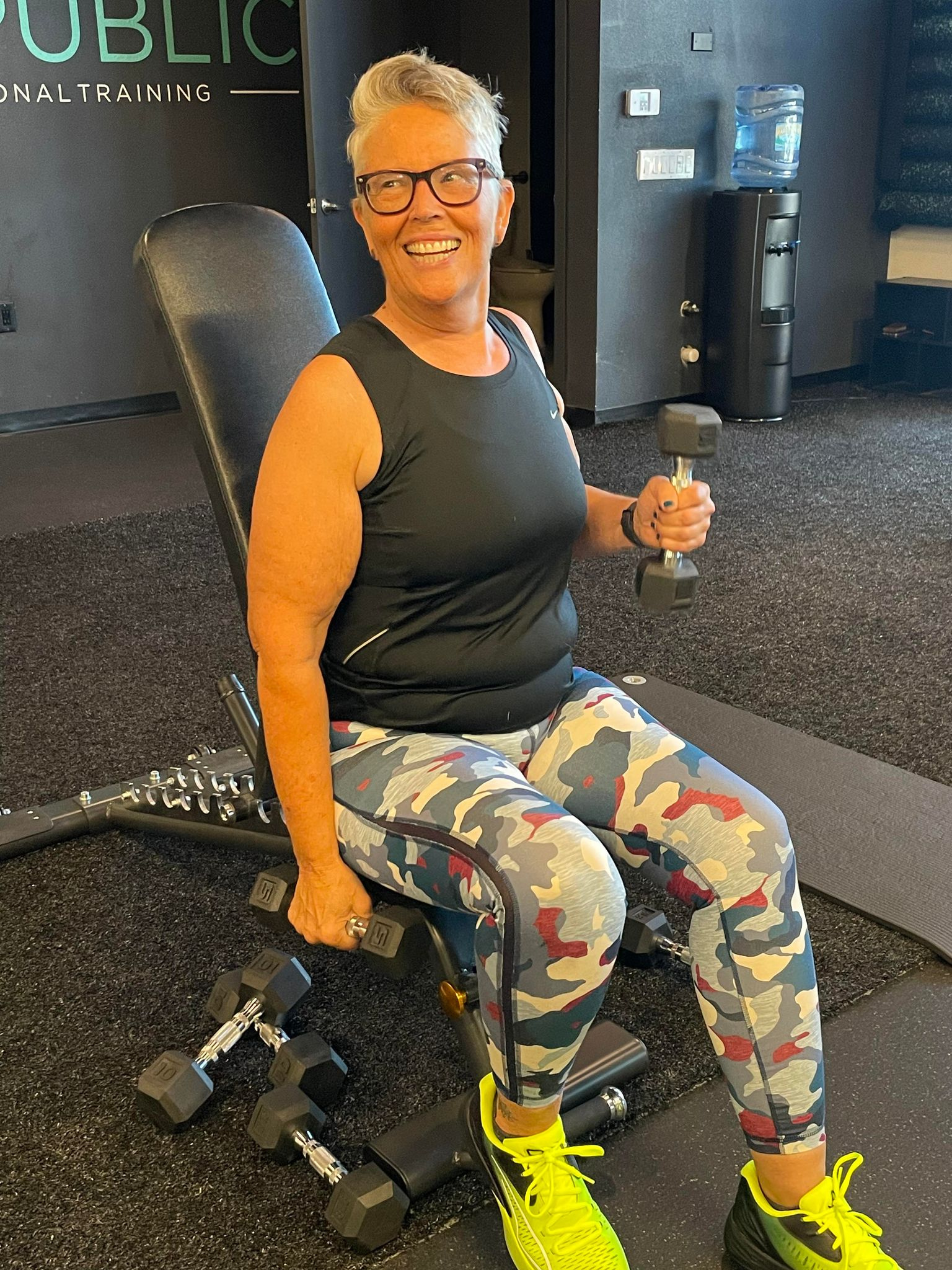
People your own age. This matters more than people think. When everyone in the room is over 40, you don't feel out of place. You don't feel judged. You see people dealing with the same stuff you deal with, training through the same limitations, and making progress. That normalizes the whole experience and makes it something you actually want to keep doing.
Starting point: You don't need to be in shape to start training. You need to start training to get in shape. Every single person at our studio started exactly where you are right now.
What Your First Month Looks Like
Week 1 is about learning. Your trainer teaches you the basic movements: how to squat safely, how to push, how to pull, how to brace your core. Everything is done with light weight or just your bodyweight. The focus is on form, not intensity. You'll probably feel a little sore the next day, which is completely normal and goes away quickly as your body adapts.
Weeks 2 and 3, you start to get comfortable. You remember the exercises without being reminded. You know where everything is in the studio. You recognize the people you train with. The soreness from week 1 is gone and you're starting to feel a little stronger. Your trainer begins to add small progressions: slightly heavier weights, a few more reps, maybe a harder variation of an exercise you've gotten the hang of.
By week 4, something shifts. You start looking forward to your sessions instead of dreading them. You notice you're sleeping better. Your energy is up. Your clothes might fit a little differently. You're not a different person yet, but you can feel the direction you're headed and it feels good.
That first month is everything. If you can get through 4 weeks with consistency and coaching, you'll have built a habit that sticks. And the improvements only accelerate from there.
New to Fitness? Start Here.
14-Day Jump Start from $149
4-6 coached sessions to ease you in. No commitment. No pressure.
The Exercises You'll Actually Do
Forget what you've seen on social media. Nobody is going to hand you a barbell and tell you to deadlift 200 pounds. The exercises for beginners over 40 are functional, practical, and scaled to your ability. Things like squatting to a box (sitting down and standing up with control), step-ups on a low platform, pushing movements for your chest and shoulders, pulling movements for your back, and core work that strengthens your midsection without crunching your spine into a pretzel.
Your trainer selects every exercise based on what your body needs and what it can handle right now. As you progress, the exercises get harder. But the progression is gradual and deliberate, not random. You'll also do balance work, especially if you're over 50, because balance and stability training is one of the most important things you can do for long-term independence and injury prevention.
If you're a woman over 40, the programming also accounts for hormonal changes. Our men's strength training guide covers the male-specific considerations. If you're a woman over 40, the programming also accounts for hormonal changes, bone density concerns, and the body composition shifts that come with perimenopause and menopause. We have a dedicated training program for women that addresses all of this.
What About the Cost?
This is a real concern for a lot of people in the east valley, and it's worth being honest about. A $10 gym membership sounds great on paper, but if you don't know what to do and you stop going after two months, you've wasted your money and your time. A private personal trainer charges $80 to $150 per session in the Coachella Valley, which adds up fast if you're training twice a week.
Semi-private training at Strong Republic starts at $33 per session. That gets you a certified trainer, a personalized program, coached sessions, nutrition guidance, and stretch therapy. It's the sweet spot between going it alone at a cheap gym and paying a fortune for one-on-one sessions.
New members start with the 14-Day Jump Start for $149 (4 sessions) or $199 (6 sessions). No long-term contract. Just come in, try it, and see if it's a fit.
You're Not Too Late
There's a voice in your head that says you should have started this 10 years ago. Maybe 20. That voice is useless. The best time to start was years ago. The second best time is this week. Your body responds to strength training at any age. People in their 50s, 60s, and 70s build muscle, lose fat, improve their balance, and completely change how they feel in their daily lives. It happens every day in our studio.
If you're wondering whether it's also important to get stronger as you age and what the research actually says, read our piece on why strength training after 50 is the best thing you can do for your body. It covers the science in plain English.
Why Indio Residents Are Choosing Strong Republic
Indio is a big city with a lot of adults over 40 who are ready to do something about their health — but not a lot of fitness options designed specifically for them. Most commercial gyms in the area cater to younger crowds. The classes move too fast. The equipment is confusing. And nobody is watching out for the person with the bad hip or the replaced knee.
That's exactly why so many Indio residents make the short drive down Highway 111 to our La Quinta studio. It's 10 minutes or less from most Indio neighborhoods, and once you walk in, it feels completely different from anything else in the valley. Small groups. Quiet. Private. A trainer who knows your name and your history before you even pick up a weight.
We've worked with Indio residents from all walks of life — retired construction workers dealing with decades of wear on their joints, women in their 50s navigating menopause, men in their 60s who want to keep golfing without the back pain. Whatever your starting point, we build around it. Not a generic program. Yours.
If you live in Indio, Coachella, Bermuda Dunes, or anywhere in the east valley, our La Quinta studio on Highway 111 is less than 10 minutes away. Walk in, meet the trainers, see the space. Nobody is going to pressure you. We'll just talk about what you're looking for and whether we're the right fit. Call (760) 509-1993 or fill out the form below.