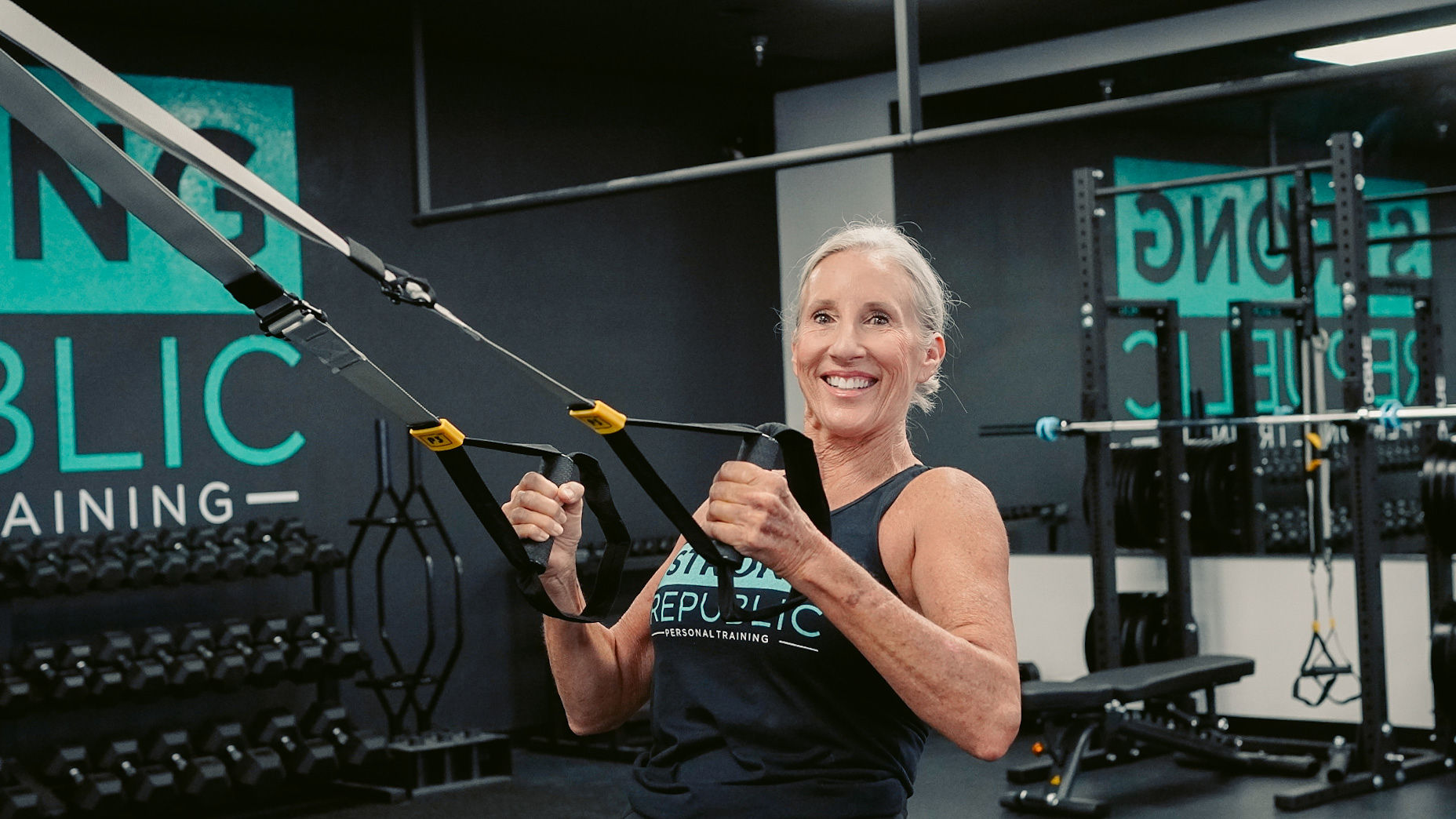
If you're in Palm Springs and taking a GLP-1 medication, here's what you need to know. If you're over 60 and your doctor has put you on Ozempic, Wegovy, Mounjaro, or another GLP-1 medication, you're in a different situation than someone who's 35 and wants to drop 20 pounds for a beach vacation. Your body is already changing in ways that make the side effects of these drugs more consequential. The weight loss works. Nobody disputes that. For a full overview of why strength training is essential on GLP-1s, read our foundational guide to GLP-1s and strength training. But the collateral damage hits harder when you're older, and most of the information out there doesn't account for that.
Here's what we see at our studios in Palm Desert, La Quinta, and Palm Springs. Members over 60 who started a GLP-1 come in lighter but weaker. Strength training matters after 40, and it matters even more after 60 on these medications. They've lost weight but their grip strength is down, their balance is worse, and they feel more fragile than they did before. That's not a success story. That's a problem with a very specific solution.
The Muscle Loss Problem Is Worse After 60
Ready to Get Strong with Us?
14-Day Jump Start from $149 · Personal training from $33/session
Longevity-focused coaches specializing in GLP-1 fitness for seniors 60+. Serving Palm Springs. No contracts.
Research published in 2025 confirmed that 26 to 40% of weight lost on GLP-1 medications is lean tissue, not fat. For a younger person with plenty of muscle to spare, that's concerning. For someone over 60 who is already losing muscle to sarcopenia, it can be devastating.
After 60, you lose muscle mass at roughly 1 to 2% per year just from aging. Layer GLP-1 induced muscle loss on top of that and you're looking at an accelerated decline in the very thing that keeps you upright, mobile, and independent. Dr. Viral Shah at Indiana University told CNN that people 65 and above who lose even 10 to 15% of lean mass on GLP-1s face significant consequences because they had less muscle to begin with.
This isn't theoretical. We see it in our studios. A 67-year-old who lost 30 pounds on semaglutide but can barely get off the couch without using their arms. A 72-year-old who dropped three pant sizes but started needing a handrail on stairs they used to take two at a time. The scale says one thing. The body says another.
Why Weight Loss Alone Can Be Dangerous After 60
For adults over 60, the goal should never be weight loss alone. Losing weight without preserving muscle can reduce balance, mobility, bone protection, metabolism, and ultimately independence. Many seniors feel encouraged by the scale dropping while simultaneously becoming physically weaker — a quiet tradeoff that doesn't show up until the day they can't get out of a low chair, can't carry groceries up the stairs, or take a fall they used to be strong enough to catch themselves on.
That is why supervised resistance training matters so much during GLP-1 treatment. The goal is not simply to weigh less. It is to remain strong, capable, and independent for decades to come. The medication helps you lose fat. The training is what makes sure the body underneath that fat is still functional when the weight loss is done.
Bone Density: The Risk Nobody Talks About
The 2026 Research on GLP-1s and Bone Loss
Brand new research presented at the American Academy of Orthopaedic Surgeons annual meeting in March 2026 found that GLP-1 medications may be linked to nearly double the risk of bone density issues at five years. The study analyzed five years of medical records from over 146,000 adults with obesity and type 2 diabetes.
Why This Hits Adults Over 60 Hardest
For adults over 60, this is especially alarming. Bone density is already declining. One in four adults over 65 falls every year according to the CDC. If you add weakened bones to weakened muscles, the fall risk and fracture risk multiply. A hip fracture after 65 has a one-year mortality rate of roughly 20 to 30%. That is not a statistic to take lightly.
How Exercise Changes the Outcome
A 2024 study published in JAMA Network Open showed that combining exercise with GLP-1 therapy preserved bone mineral density at the hip, spine, and forearm. GLP-1 therapy alone led to reduced bone density at those same sites. The message from the research is clear: the medication alone makes your bones weaker, but adding exercise, especially weight-bearing and resistance exercise, protects them.
Dehydration and Fall Risk
The GI Side Effects That Lead to Falls
GLP-1 medications commonly cause nausea, vomiting, and reduced appetite. For older adults, those side effects can quickly lead to dehydration. Harbor Health's clinical team has noted that severe GI side effects from GLP-1 drugs can cause dehydration that leads to dizziness and falls. Combine that with the muscle weakness and bone density decline we just covered and you have a recipe for exactly the kind of injury that changes an older person's life permanently.
Balance Training Is Not Optional
Balance training and fall prevention should be a mandatory part of any exercise program for seniors on GLP-1 medications. Not optional. Not something you'll get to eventually. From day one.
What Seniors on GLP-1s Need to Be Doing
Resistance Training 2-3 Times Per Week
The research points to a clear program. Resistance training 2 to 3 times per week targeting all major muscle groups. Read why strength training beats cardio on GLP-1s for the full breakdown. This is the single most important thing you can do to preserve muscle and bone. The European Association for the Study of Obesity has specifically highlighted that resistance training, not cardio, is what prevents lean mass loss during weight loss.
Balance and Stability Every Session
Balance and stability work every session. Single-leg stands, heel-to-toe walking, lateral movements, and functional exercises that challenge your coordination. These directly reduce fall risk.
Protein Intake Despite Reduced Appetite
High protein intake despite reduced appetite. The ACE recommends 1.2 to 2.0 grams per kilogram of body weight daily for GLP-1 users. When your appetite is suppressed, every meal needs to lead with protein. Our Strong Elite Nutrition program helps members plan around appetite suppression.
Supervision Built for the Over-60 Body
And supervision matters. A senior fitness program run by senior fitness coaches who understand GLP-1 side effects, aging bodies, joint replacements, arthritis, and osteoporosis is fundamentally different from a general gym membership. Intensity needs to start lower and progress more gradually. Sessions should be shorter to accommodate nausea and fatigue. And your coach needs to know how to adjust on the fly when you walk in feeling rough.
GLP-1 Support for Seniors in Palm Springs
Many Palm Springs retirees begin GLP-1 medications to improve health markers and mobility, but few realize how quickly muscle loss can accelerate after 60 without resistance training.
Palm Springs has one of the oldest adult populations in California, and one of the highest rates of GLP-1 prescriptions. We see the results of this combination regularly — seniors who've lost weight but arrived at our Palm Springs studio weaker, less stable, and more at risk than before they started the medication. That outcome is preventable, but only if the right training starts early.
We work with adults over 60 from Palm Springs, Cathedral City, Desert Hot Springs, and the surrounding area. Our programs for GLP-1 users over 60 focus on the four things that matter most: preserving muscle, protecting bone density, improving balance, and building the strength to stay independent. Call (760) 509-1993 or fill out the form below.
The Coachella Valley Factor
Living in the desert adds another layer. The heat causes faster dehydration. People assume they're warmed up because it's 100 degrees outside, so they skip proper warmups. And the active lifestyle out here, golf, pickleball, hiking, means many seniors are already placing high demands on their bodies before adding medication-induced muscle loss to the equation.
Nutrient Deficiencies Most Seniors Miss
UC Davis Health researchers have highlighted that GLP-1 medications create specific nutritional challenges beyond just protein. When you eat less overall, you're likely missing critical micronutrients. For seniors, the biggest concerns are vitamin D, calcium, magnesium, iron, folate, and B12. All of these are essential for bone health, muscle function, and energy production.
Vitamin D is especially relevant in the Coachella Valley. You'd think with all that sunshine it wouldn't be an issue, but many seniors here spend the hottest months indoors, and sunscreen blocks vitamin D synthesis. Pair that with reduced food intake from a GLP-1, and deficiencies are more common than you'd expect. Our Strong Elite Nutrition program helps members identify and address these gaps.
The Independence Factor
For seniors, fitness isn't about looking good in a bathing suit. It's about independence. Can you get up from a low chair without using your arms? Can you carry your own suitcase through the airport? Can you catch yourself if you trip on a curb? Can you pick up your grandchild? Every one of those abilities depends on having enough muscle and enough balance to do it safely.
GLP-1 medications threaten those abilities if muscle loss goes unchecked. A structured senior fitness program preserves the muscle and balance that keep you living on your own terms. That's not a luxury. For someone over 60, it might be the most important investment you make in your health alongside the medication itself.
What to Tell Your Doctor
If you're over 60 and your doctor is prescribing a GLP-1, ask them specifically about muscle preservation and bone density monitoring. Women face compounding risks from menopause, covered in the best exercise program for women over 50 on GLP-1s. Request a DEXA scan before starting the medication so you have a baseline. Ask about protein targets. And tell them you're starting or continuing a supervised resistance training program. Most doctors will be encouraged by that because they know the research supports it. The problem is that most patients never bring it up, and a 15-minute appointment doesn't leave much time for the doctor to cover it either.
For the broader picture on training while on Ozempic, Wegovy, or Mounjaro at any age, see our GLP-1 strength training for adults over 40 resource hub.
Call Palm Desert at (760) 766-0934, La Quinta at (760) 509-1993, or Palm Springs at (760) 388-2638.