The strength side of the conversation most adults are missing.
Adults over 40 using GLP-1 medications or medically supervised peptide support often focus on weight loss. But long-term health depends on protecting muscle, strength, mobility, metabolism, and movement quality along the way.
The goal is not simply to lose weight. The goal is building a body that stays strong, capable, and active for decades.
After 40, the body changes in ways that make how you lose weight matter as much as whether you lose it at all.
Muscle naturally declines with age. By the time most adults hit their 40s and 50s, they are already losing lean tissue every year unless they actively work to maintain it. Add rapid weight loss to that without resistance training, and the muscle loss can accelerate. The body breaks down lean tissue alongside fat, especially when protein intake drops or training stops.
Loss of muscle affects more than the way clothes fit. It slows metabolism, weakens balance, reduces grip strength, and makes everyday movement harder. Adults often notice fatigue, instability, or a vague sense of feeling weaker after fast weight loss — even when the number on the scale is the lowest it has been in years.
This is the conversation that does not get enough airtime. Sarcopenia, the age-related loss of muscle and strength, becomes a serious factor after 50 and a real risk after 60. Mobility narrows. Posture shifts. Joints carry more load when the muscles around them weaken. Energy levels drop. The path to losing independence later in life almost always runs through losing strength first.
The good news: strength training reverses or slows nearly all of it. The work just needs to actually happen.
These medications do what they are designed to do. The challenge is what happens to muscle, recovery, and long-term function while they work.
GLP-1 medications and medically supervised peptide protocols often reduce appetite, accelerate weight loss, and lower overall calorie intake. That can be useful for the goals adults set out to achieve. But the same effects also create real challenges for muscle preservation: less food often means less protein, less recovery capacity, and less raw material for the body to maintain lean tissue.
Without resistance training, the body has no strong signal to hold onto muscle. It pulls energy from wherever it can — including lean tissue. That is why strength training matters more during weight loss, not less. It tells the body which tissue to keep.
Strength training during this kind of weight loss helps protect:
A note on what we do. Strong Republic does not prescribe medications or peptides. We provide the strength training, nutrition guidance, mobility work, and accountability that support adults following their own provider's medical guidance.
Two people can weigh the same while feeling completely different physically. Body composition matters far more than simply weighing less.
Resistance-first training designed to protect lean tissue while you lose weight, so what comes off is fat — not the muscle you need for the next 30 years.
Lean muscle drives metabolism. Protect it during weight loss and your body keeps burning energy efficiently, which is the real foundation of weight that stays off.
Rapid weight loss can quietly reduce bone density, especially after 50. Loaded resistance training is one of the most reliable ways to protect skeletal strength.
Strength is what makes everyday life feel easy. Stability is what keeps you upright. Both decline without training and both come back with consistent strength work.
Hip, shoulder, ankle, and spine mobility matter more after 40, not less. Smart programming protects ranges of motion as the body changes.
The work compounds. Strength built in your 40s and 50s pays off in your 60s, 70s, and beyond — in independence, energy, and quality of life.
The body after 40 is not the body at 25. The way it responds to training, recovery, and stress is genuinely different.
Recovery slows. Joints carry more wear. Sleep matters more. For women, menopause shifts hormones that affect bone density, body composition, and how training feels. For men, gradually lower testosterone affects muscle retention and recovery. Both groups deal with more sitting, more stress, and less spontaneous activity than they did twenty years earlier.
None of that means training stops working. It just means the approach has to change.
Smarter looks like progression that respects recovery. Modifications that protect joints. Mobility built into every session, not bolted on at the end. Coaches who notice when you walk in carrying stress and adjust accordingly. The work is steady, not punishing. The point is to still be doing this in twenty years.
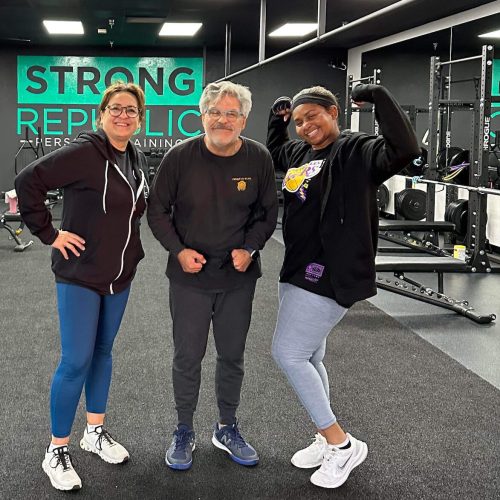
Strong Republic focuses on sustainable strength, body composition, movement quality, mobility, consistency, and quality of life. Not extreme dieting, punishment workouts, or rapid transformation culture. The work happens through coach-led personal training in semi-private sessions, where each program is built around the individual rather than the group.
Progressive resistance work built around the over-40 body, the way it actually responds to training.
Hip, shoulder, ankle, and spine mobility built into every session, because strength only matters if you can move.
Programming that respects sleep, stress, and the realities of an active adult life. Productive sessions, not punishing ones.
The whole approach is built around protecting lean tissue, especially during periods of weight loss.
The kind that comes from knowing your body still works the way you want it to. Not a small thing after 40.
Training that holds up for the next twenty years. Independence, mobility, and capability for decades.
One member came in after losing significant weight on a GLP-1 medication. The scale was the lowest it had been in fifteen years. But she felt weaker, more unstable on her feet, and noticeably less energetic during everyday activities. Stairs felt harder. Her grip felt softer. After several months of consistent strength training, that changed. Her posture improved, her energy came back, her balance felt steady again, and her body started feeling capable in a way the scale alone never delivered.
The weight loss is the part most people focus on. The strength, posture, and confidence underneath it are what actually change how the next twenty years feel.
Most members are not chasing peak performance. They are chasing the kind of strength that holds up for the long haul.
That means traveling without feeling wrecked the next day. Playing golf or pickleball for decades, not just seasons. Hiking on vacation without limping home. Carrying grandkids without thinking about it. Standing up from a low chair without bracing. The everyday confidence that your body still does what you ask it to.
It also means the bigger picture: avoiding fragility, staying independent, keeping balance and mobility, and aging in a way that does not slowly close down what you can do. The data on this is consistent — strength is one of the most reliable predictors of healthy aging across nearly every measure that matters. Adults who maintain strength often preserve more capability, independence, and quality of life as they age.
That is the standard the work is built around. Not a six-week sprint. A twenty-year arc.
Three studios across the Coachella Valley. Each location offers the same coach-led strength training designed around adults over 40 using GLP-1s, peptides, or medically supervised weight-loss support — with a feel tailored to its community.
Calm, premium, longevity-focused strength training.
4741 E. Palm Canyon, Suite E
Palm Springs, CA 92264
Coach-led strength training for adults over 40 protecting muscle, mobility, and metabolism while losing weight. Serving Palm Springs, Cathedral City, and Rancho Mirage.
Palm Springs Peptide Strength →Structured coaching for muscle preservation and longevity.
77780 Country Club Dr. Suite A1
Palm Desert, CA 92211
Semi-private strength training for adults over 40 using GLP-1s or peptide support. Serving Palm Desert, Indian Wells, Bermuda Dunes, and Rancho Mirage.
Palm Desert Peptide Strength →Active-aging strength for golf, pickleball, and longevity.
78575 CA-111, Suite 400
La Quinta, CA 92253
Strength coaching for active adults using GLP-1s or peptide support who want to stay strong for golf, pickleball, hiking, and travel. Serving La Quinta, PGA West, SilverRock, Old Town, and Indian Wells.
La Quinta Peptide Strength →No. Peptides or GLP-1s may be part of a medically supervised plan, but they do not replace resistance training, protein, recovery, and consistency. Strength training is what protects the muscle, mobility, and metabolism that make weight loss sustainable after 40.
After 40, adults gradually lose muscle each year unless they actively work to maintain it. Muscle drives metabolism, supports joints, protects balance, and keeps everyday movement easy. Without it, adults often feel weaker, less stable, and less capable as they age — even at the same body weight.
When the body is in a calorie deficit without enough protein and a strong resistance training stimulus, it can break down muscle tissue alongside fat. Rapid weight loss without strength training and adequate protein often leaves adults smaller but not stronger, and can quietly reduce metabolism, mobility, and long-term resilience.
Yes. Lower appetite on GLP-1 medications can make adequate protein and recovery harder, which makes resistance training more important, not less. Strength training helps protect lean muscle, support metabolism, and maintain the mobility and movement quality that matter for long-term health.
Yes. Adults in their 50s, 60s, and 70s build strength regularly with the right coaching. Progress is steady rather than dramatic, but the gains in strength, mobility, energy, and confidence are real and protective for healthy aging.
Body composition matters far more than body weight. Two people can weigh the same and feel completely different physically. The mix of muscle, fat, mobility, and movement quality is what determines how strong, capable, and energetic you actually feel — not the number on the scale.
If you are using GLP-1 medications or medically supervised peptide support, strength training can help protect the muscle, metabolism, mobility, and confidence that support long-term quality of life after 40.
Find Your Strength Training Location